Quick summary from Casey — under 30 seconds
The numbers that matter
40-60%
of local search clicks go to the map pack
#1
ranking factor you control: primary category
$0
cost per click from your Google Business Profile
12
factors in the self audit scorecard below
Score your own Google Business Profile in 2 minutes
Free interactive tool, included in this article
For most law firms, Google Business Profile (GBP) optimization is the single most important local SEO asset. It’s what determines whether you appear in the local 3-pack (those three business listings that appear at the top of local searches). Here’s everything you need to know to optimize it.
Why Google Business Profile Matters for Law Firms
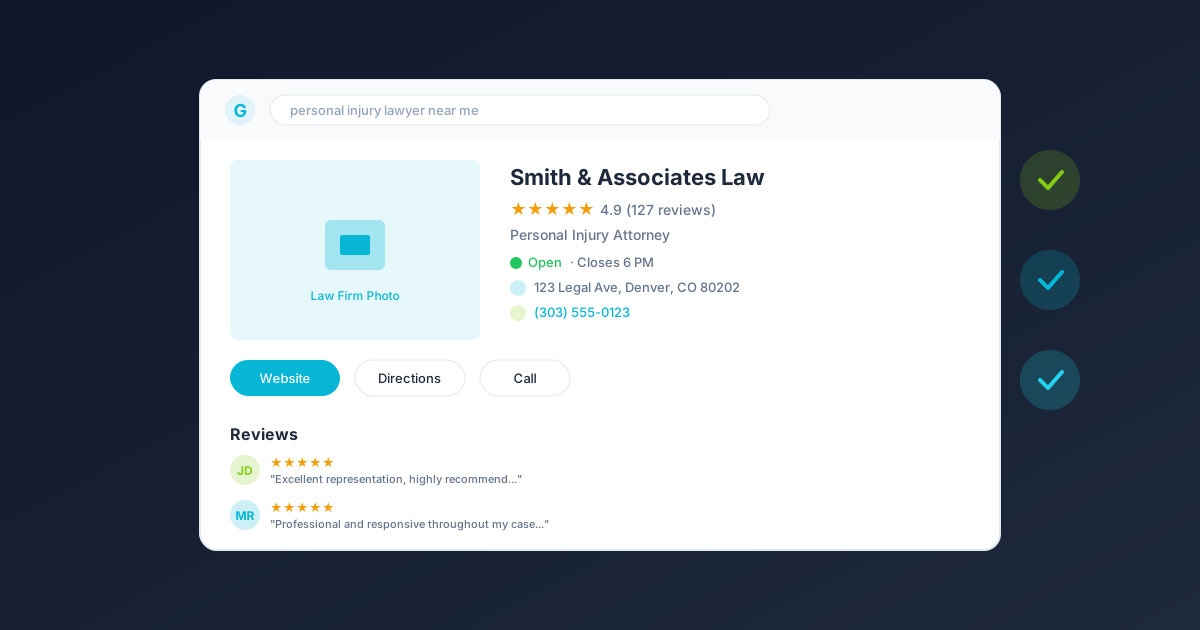
When someone searches “personal injury lawyer near me” or “divorce attorney [city],” Google typically shows three results in the map pack before any organic listings. These map pack results get the lion’s share of clicks. For competitive practice areas like personal injury lawyer marketing, dominating the map pack is essential.
According to BrightLocal’s local consumer survey data, the map pack receives 40-60% of clicks for local intent searches. If your firm is not appearing there, you are missing most potential clients who search for your services.
Unlike paid search ads where you pay $50-200+ per click for legal keywords, Google Business Profile visibility is free. The investment is in optimization and ongoing management, not per-click costs. For law firms that depend on local client acquisition — which is most of them — a well-optimized Google Business Profile delivers one of the highest returns on investment of any digital marketing channel.
Google Business Profile optimization also compounds over time. As you accumulate reviews, post consistently, build citations, and earn engagement signals, your listing’s authority grows. Newer competitors cannot simply outspend you — they have to out-earn these signals over months and years. This is why firms that start optimizing early and maintain consistency build a durable competitive advantage in their local market.
Setting Up Your Google Business Profile
Claiming and Verifying
If you haven’t already, claim your Google Business Profile at business.google.com. Verification typically requires:
- Receiving a postcard at your physical address
- Phone verification (sometimes available)
- Video verification (increasingly common)
Pro tip: Use your primary office address. Google requires a physical location where you meet clients — P.O. boxes and virtual office addresses do not qualify and can result in suspension. If you recently moved offices, update your Google Business Profile address immediately and ensure the new address is reflected across all citation sources within the same week to avoid NAP inconsistency issues.
Choosing the Right Google Business Profile Categories
Your primary category is the most important ranking factor you control. For law firms, common categories include:
- Personal injury attorney
- Divorce lawyer
- Criminal defense attorney
- Estate planning attorney
- Immigration attorney
- Law firm (as secondary)
Choose the most specific category that applies. “Personal injury attorney” will outrank “Law firm” for personal injury searches because Google uses your primary category as one of the strongest signals when deciding which listings to show for a given query.
You can add up to 10 categories, but your primary category matters most. Add secondary categories for other practice areas you actively serve, but do not dilute with irrelevant options. A common mistake is adding categories for practice areas you rarely handle — this can actually hurt your relevance for the areas that matter most.
For multi-practice firms, prioritize the practice area that generates the most revenue or has the highest case value as your primary category. If you are a personal injury firm that also handles some family law cases, your primary should be “Personal injury attorney” — not “Law firm” or “Lawyer.”
Optimization Essentials
Business Name
Your GBP name should be your actual business name-nothing more, nothing less. Adding keywords (“Martinez Personal Injury Law — Dallas | Personal Injury Lawyer”) violates Google’s guidelines and risks suspension.
Some competitors do this. Don’t follow them. Google is increasingly strict about enforcement.
Address and Service Areas
List your physical office address. If you serve clients across a region, you can also define service areas (cities, counties, or zip codes you serve).
Important: Don’t create fake listings for cities where you don’t have offices. This violates guidelines and can result in all your listings being suspended.
Phone Number
Use a local phone number (not toll-free) as your primary number. Local numbers signal to Google that you’re actually located in that area.
Ensure this number is consistent across all online directories — inconsistencies confuse Google and hurt rankings. Use a call tracking number from a provider like CallRail as your primary if you need attribution data, but make sure the tracking number is consistent across all listings and that your actual local number is listed as the secondary number in your Google Business Profile.
Website URL
Link to your homepage or, better, a location-specific landing page if you have multiple offices. Ensure the page you link to includes your NAP (Name, Address, Phone) prominently.
Hours of Operation
List accurate hours. If you take calls 24/7 for emergencies, note that. If you’re only available by appointment, use those settings.
Inconsistent hours (especially showing “closed” when you’re actually available) frustrates potential clients and can hurt your local ranking.
Content Optimization
Business Description
You have 750 characters to describe your firm. Use them wisely:
- Lead with your primary practice areas
- Mention your service area naturally
- Highlight differentiators (experience, results, approach)
- Include a clear call to action
Example: “Martinez Personal Injury Law — Dallas has represented personal injury victims in Dallas for over 25 years. Our attorneys have recovered more than $100 million for clients injured in car accidents, truck accidents, and workplace incidents. We work on contingency: you pay nothing unless we win. Call today for a free consultation.”
Here is an example of a well-optimized 750-character Google Business Profile description for a personal injury firm:
“Smith & Associates is a personal injury law firm serving Dallas and the surrounding area. Our attorneys represent clients injured in car accidents, truck accidents, slip and fall incidents, and wrongful death claims. We work on a contingency fee — you pay nothing unless we win. With 25 years of combined experience and over $100 million recovered for clients, we are committed to getting you the compensation you deserve. Call today for a free consultation.”
Notice what this description does: it names practice areas explicitly, includes the city, states the fee structure, includes a proof point, and ends with a CTA. No keyword stuffing. No fake location names. Just clear, verifiable information.
Services
List all your practice areas as services. Be specific:
- Car Accident Attorney
- Truck Accident Lawyer
- Wrongful Death Claims
- Slip and Fall Injuries
This helps you appear in more specific searches. Write a brief description for each service that includes natural location references and the specific legal issue it addresses. For example, under “Car Accident Attorney” you might write: “Representing car accident victims in Dallas and surrounding communities. We handle insurance claims, property damage, and personal injury cases on a contingency basis.”
Google uses your services list to understand the breadth of your practice and match your listing to relevant queries. Firms that take the time to fill out detailed service descriptions consistently appear for a wider range of search terms than those that leave services blank or list only practice area names without context.
Products
Some firms use the “Products” feature to highlight specific services with images and descriptions. This can make your listing more visually appealing and informative. Products appear as scrollable cards on your Google Business Profile, each with an image, title, price range (optional), and description. For law firms, use Products to showcase your core practice areas with a brief description and a link to the corresponding page on your website. This gives potential clients another entry point into your services and adds additional keyword-relevant content to your profile.
Photos and Visual Content
Listings with photos receive 35% more clicks than those without. Include:
Essential Photos
- Exterior: Your office building/entrance
- Interior: Reception area, conference room
- Team: Professional headshots of attorneys
- Logo: Your firm’s logo
Additional Visuals
- Office environment
- Community involvement
- Awards and recognition
- Client meeting rooms
Quality matters: Professional photography makes a significant difference. Avoid blurry, poorly lit images.
Photo Optimization Tips for Law Firms
Upload new photos at least once per month to signal profile freshness. Google tracks photo recency, and listings with recently uploaded images tend to receive more visibility than stale profiles. Geotagging photos with your office location metadata can reinforce your local relevance, though this is not required.
Name your image files descriptively before uploading — “dallas-personal-injury-attorney-office.jpg” is better than “IMG_4521.jpg.” While Google has not confirmed that file names directly influence local rankings, descriptive naming is a best practice that reinforces your content signals.
For firms with multiple attorneys, upload individual headshots with each attorney’s name in the file name. This helps build entity associations between your attorneys and your Google Business Profile listing, which can strengthen your firm’s overall local authority.
Why Are Reviews Critical for Lawyer GBP Rankings?
Why Law Firm Reviews Dominate Local SEO
Reviews are arguably the most important factor in local SEO for lawyers. Understanding local ranking factors shows that reviews influence:
- Ranking: More positive reviews generally correlates with higher map pack positions
- Click-through rate: Firms with more/better reviews get more clicks
- Conversion: Reviews build trust that leads to consultations by demonstrating E-E-A-T signals Google values
Generating Reviews Systematically
The firms that dominate local search have systems for generating reviews consistently. Consider:
- Ask at the right moment: After a successful outcome or positive interaction
- Make it easy: Provide a direct link to your Google review page
- Follow up: Gentle reminders to clients who agreed but haven’t reviewed yet
- Train your team: Everyone should understand the importance of reviews
Responding to Reviews
Respond to every review-positive and negative.
For positive reviews: Thank them genuinely. Mention their specific case type if appropriate (this adds relevant keywords naturally).
For negative reviews: Respond professionally, acknowledge their concern, and invite offline resolution. Never argue publicly or reveal client confidential information. A thoughtful response to a negative review can actually improve your conversion rate — potential clients see that you handle criticism gracefully, which builds trust.
Review Velocity and Its Impact on Rankings
Review velocity — the rate at which you receive new reviews — is a stronger ranking signal than your total review count alone. A firm with 50 reviews that received 10 in the last month will often outrank a firm with 200 reviews that has not received one in six months. Focus on building a consistent flow of reviews rather than a one-time push. Aim for 2-4 new Google reviews per month at minimum, and track this as a KPI alongside your other local SEO metrics.
Monitoring Review Performance: Use BrightLocal to monitor review velocity and track your overall rating across platforms. This gives you a clear picture of how your review profile compares to competitors in your market.
How to Use Google Posts to Signal Relevance to Google
Most law firms either ignore Google Posts entirely or post once and forget about it. That is a mistake — Google Posts are one of the few direct signals you control that tell Google your profile is active and relevant.
Post at minimum once per week. The content does not need to be long. Effective post types for attorneys include: anonymized case results (“Our client received a $1.2M settlement after a trucking accident — here is what made the difference”), answers to common client questions, links to new blog content, and firm news like awards or attorney spotlights.
Every post should include a CTA button. Use “Learn More” linking to a relevant practice area page, or “Call Now” for high-intent posts. Posts expire after 7 days for standard posts, so consistency matters — set a weekly calendar reminder or assign it to a staff member.
Review velocity matters here too. Law firms that post regularly see stronger engagement signals, which compounds with review velocity and photo freshness to build overall profile authority.
Post Types That Work for Law Firms
- Case result posts: Share notable outcomes where ethically permitted. For example, “Secured $1.2M settlement for a client injured in a commercial truck accident.” Avoid identifying details and always follow your state bar’s advertising rules.
- Legal tip posts: Offer practical advice like “3 things to do immediately after a car accident” or “What to know before filing for divorce in [state].” These demonstrate expertise and attract clicks.
- Community involvement: Highlight sponsorships, charity work, or pro bono efforts. These build local relevance signals and humanize your firm.
- Firm news: New attorney hires, awards, office expansions, or speaking engagements all make strong post content.
- Offer posts: Free consultation offers remain one of the highest-engagement post types for law firms.
Posting Frequency and Best Practices
Aim for 1-2 posts per week. Posts expire after 7 days (except event posts), so a consistent schedule keeps fresh content visible on your listing at all times. When formatting posts, use a compelling headline, keep the body under 300 words, include a clear call-to-action button (like “Call now” or “Learn more”), and add a relevant image. Posts with images receive significantly more engagement than text-only posts.
How to Seed and Manage Google Q&A on Your Law Firm Profile
Google Q&A is the most underused feature on attorney Google Business Profile listings. Anyone can post a question on your listing — including you. That means you can seed it with the exact questions your clients ask most, then answer them yourself before a stranger does it badly.
Start by posting 5-10 of your most common intake questions. For a Dallas personal injury firm, that might be: “Do I pay anything upfront to hire a personal injury lawyer?” or “How long does a car accident case take to settle?” Answer each one thoroughly, naturally including location and practice area language.
This matters for two reasons: Google indexes Q&A content and it surfaces in search, and it directly resolves decision blockers for potential clients who are evaluating your firm. Unlike your 750-character business description, Q&A has no length limit on answers. Use it.
Monitor Q&A weekly — anyone can post a question or upvote answers, and spammers occasionally abuse the feature on attorney profiles.
Questions to Seed for Law Firms
Focus on the questions potential clients actually ask before hiring an attorney:
- “Do you offer free consultations?”
- “What areas do you serve?”
- “How much does a consultation cost?” or “What are your fees?”
- “What types of cases do you handle?”
- “How long does a [case type] case typically take?”
- “What should I bring to my first appointment?”
- “Do you work on contingency?”
Why Q&A Matters for Rankings
Each question and answer pair adds keyword-rich content to your listing. When a potential client asks about “car accident cases in [city]” and your answer addresses that topic, it reinforces your relevance for those search terms. Google can surface Q&A content in search results, giving your listing additional visibility.
Monitoring for Spam
Check your Q&A section regularly. Competitors or disgruntled individuals sometimes post misleading questions or answers. You can report inappropriate content, and having your own answers already in place reduces the impact of any inaccurate responses from outside users. Answer from your business profile so your responses are clearly marked as the business owner’s reply.
Monitoring and Maintenance
Regular Audits
Monthly, check your Google Business Profile listing for:
- Suggested edits: Google allows anyone to suggest changes to your listing. Competitors or well-meaning users sometimes submit incorrect edits to your hours, phone number, or even business name. Reject any inaccurate suggestions immediately.
- New reviews needing responses: Respond to every review within 48 hours. Both positive and negative reviews require a professional reply.
- Questions needing answers: Check for new user-submitted questions and answer them from your business account before someone else provides an inaccurate response.
- Photo suggestions to reject: Competitors sometimes suggest misleading images. Review and reject any that do not accurately represent your firm.
- Category changes: Periodically review whether your primary and secondary categories still reflect your practice areas accurately, especially if you have expanded into new areas of law.
Ongoing Optimization
Google Business Profile optimization is not a one-time setup — it requires ongoing attention to maintain and improve your local rankings. Set a quarterly reminder to review your full profile against competitors in your market. Check whether new Google Business Profile features have launched that you are not yet using, compare your review count and rating to the top three competitors in your local pack, and assess whether your business description and services list still reflect your current practice areas and differentiators.
Common Mistakes to Avoid
1. Keyword Stuffing Your Name
Adding keywords to your business name violates guidelines. Stick to your legal business name.
2. Creating Multiple Listings
One listing per physical location. Creating fake listings for areas you don’t have offices will backfire.
3. Neglecting Reviews
Your competitors are actively generating reviews. If you’re not, you’re falling behind.
4. Inconsistent Information
Your NAP must match exactly across Google, your website, and all directories. Inconsistencies hurt rankings.
For law firms specifically, the highest-priority citation sources beyond the major aggregators are: Avvo, Justia, FindLaw, SuperLawyers, and Lawyers.com. These legal directories carry outsized authority in Google’s local algorithm for attorney searches because they are topically relevant — not just geographically relevant. Beyond those, ensure your NAP is consistent on Yelp, BBB, and your local bar association directory. Use Whitespark or BrightLocal to audit inconsistencies across all sources before building new citations.
5. Ignoring Negative Reviews
Unanswered negative reviews look worse than the review itself. Always respond professionally.
Tracking Your GBP Performance with Profile Insights
Once your profile is optimized, open Google Business Profile Insights regularly to track the metrics that actually matter for your firm’s growth. The key data points to monitor include:
- Search queries: What terms are people using to find your listing? This reveals which practice areas are driving visibility and whether your category and content optimization is working. If you are a personal injury firm but most impressions come from “free consultation” queries, your practice area signals may need strengthening.
- Customer actions: How many people called directly from the profile, requested directions, or clicked through to your website? Calls from the profile are the highest-intent action — track this number month over month.
- Direction requests: A spike in direction requests often correlates with strong local pack positioning. If directions are growing while calls are flat, consider whether your listing CTA or phone number placement needs improvement.
- Photo views: Compare your photo view count to the competitor average Google provides. Firms with more photos and higher engagement consistently outperform those with minimal visual content.
Set a monthly reminder to review Insights. If calls from the profile are flat while impressions are growing, the issue is likely your profile CTA or review count — not your ranking. If impressions are flat, the issue is category selection or citation authority.
Pair Google Business Profile Insights with Google Search Console data to understand how your local listing performance connects to your broader organic search presence. For tracking local pack rankings over time, tools like Semrush, Ahrefs, or Local Falcon let you monitor position changes for your target keywords across specific geographic grid points.
Does a Law Firm Need a Google Business Profile?
Yes. Every law firm needs a Google Business Profile, even a firm that gets all of its cases from referrals. Here is why there is no real exception:
- It is free, and it ranks. The map pack appears above organic results for nearly every “lawyer near me” and “[practice area] attorney [city]” search. No profile means no chance at 40 to 60% of local search clicks.
- Clients use it to vet you, not just find you. Referred clients still Google your firm name before calling. A missing or thin profile with no reviews reads as a warning sign.
- It feeds AI search. ChatGPT, Perplexity, and Google’s AI Overviews pull local business data heavily from Google’s business listings. Firms without a profile are invisible to an entire layer of how people now find legal help.
- Someone else may create it if you don’t. Google allows users to suggest businesses, which means an unclaimed, unmanaged listing with wrong hours and no photos can exist for your firm right now.
The only real question is how much attention it deserves, and the answer scales with how much of your work comes from local search. A solo estate planner in a small town needs the basics done right. A personal injury firm in a major metro needs the full system described in this guide.
One related question I get constantly is whether paid citation tools are worth adding on top. I wrote up an honest answer in Is Moz Local worth it for law firms?
The Bottom Line
Google Business Profile optimization is foundational for law firm local SEO. Combined with a comprehensive SEO strategy, a well-optimized listing can mean the difference between appearing in the coveted local 3-pack and being invisible to the people who are actively searching for legal help in your market.
The tactics in this guide are not complicated, but they require consistent attention. Choose the right categories. Write a description that names your practice areas and city. Generate reviews systematically. Post every week. Seed your Q&A. Upload fresh photos monthly. Monitor your Insights and adjust. The firms that invest in Google Business Profile optimization consistently outperform those that set it and forget it.
Google Business Profile optimization is an ongoing process, not a one-time project. The local search landscape changes regularly — Google adds new features, adjusts ranking factors, and updates its guidelines. Staying on top of these changes is what separates firms that dominate the local pack from firms that wonder why their phone stopped ringing.
Juris Digital provides ongoing Google Business Profile management as part of our comprehensive local SEO services for law firms across the US, UK, and Ireland.
Need help optimizing your firm’s local presence? Let’s talk about a comprehensive local SEO strategy.
Interactive Tool
Score Your Google Business Profile in 2 Minutes
Check every statement that is true for your firm's profile. These are the same factors I audit for attorneys and solicitors in the US, UK, and Ireland.
Your Score
0/12
Tick the boxes above to see how your profile stacks up.
Topics
Related Articles
Why Law Firms Need a Specialized SEO Expert in 2026
Discover why generic SEO agencies fail law firms and how a specialized law firm SEO expert can deliver significant results for your practice.
Read MoreThe 'Don't Pay Until You Rank' Trap: Why Performance SEO Fails Law Firms That Want to Win
Pay-for-performance SEO sounds risk-free. But when Google changes its algorithm, these agencies have no income to fix your rankings. Here's what actually happens.
Read MoreStop Buying Backlinks. Build Something Worth Citing.
Two GJEL resources show how law firms build useful assets, pitch distinct stories, and improve those assets over time to earn attention and links.
Read MoreNeed Help With Your Law Firm's Marketing?
With 15+ years of experience helping law firms grow through SEO and digital marketing, I can help you develop a strategy that delivers results.