The 'Don't Pay Until You Rank' Trap: Why Performance SEO Fails Law Firms That Want to Win
Quick summary from Casey — under 30 seconds
It sounds like the perfect deal.
“You don’t pay us a dime until your keywords rank on page one.” No retainers. No risk. Just results.
I’ve been in legal SEO for over 15 years. I’ve watched this pitch land with law firm after law firm. It’s compelling - especially for attorneys who have been burned by agencies that took big monthly checks and delivered nothing. The performance model feels like it removes the risk entirely.
It doesn’t. It shifts the risk - and stacks it up for a much uglier failure later.
Here’s what actually happens.
How the Model Works (And Why It Sounds Smart)
Pay-for-performance SEO is straightforward on paper. The agency identifies a set of target keywords - typically “personal injury lawyer [city]” or “DUI attorney [city]” - and only charges you when those terms hit page one. Some variations charge per lead generated, per call, or per form submission.
The logic is clean: if the agency doesn’t perform, you don’t pay. They’re incentivized to get results.
Except the incentive structure does something else entirely. When you’re only paid after ranking, you need to get there fast and cheap. That means tactics that actually work in the short term but are built to be abandoned.
Private blog networks (PBNs). Link farms. Keyword-stuffed thin content. Mass directory submissions. These approaches can get a site to page one quickly. They can also get a site wiped off Google entirely - and they do, repeatedly, every time Google pushes a major algorithm update.
According to research on black-hat link building practices, PBN-powered pages are three times more likely to lose their rankings after a Google algorithm update compared to sites built with legitimate link-building strategies. That’s not a small risk premium. That’s a fundamentally broken foundation.
The Real Problem: What Happens When Google Updates
Here’s the question nobody asks during the pitch: what happens when Google changes its algorithm?
Google runs hundreds of algorithm updates every year. Major core updates - the ones that move entire markets - hit several times annually. The March 2024 core update was one of the most significant in years, specifically designed to reduce low-quality, manipulative content in search results. The August 2024 core update continued that work.
Law firm websites are classified as YMYL - “Your Money or Your Life” - which means Google holds them to a higher standard than almost any other category. When a core update rolls through, legal sites feel it harder and recover more slowly than most.
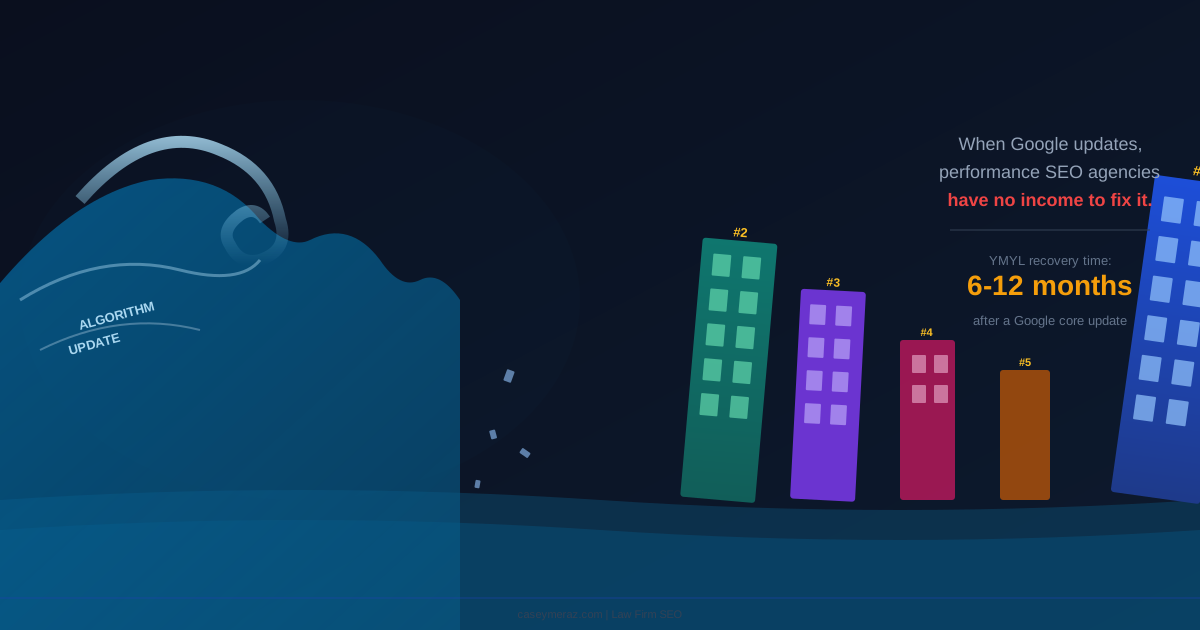
Recovery from a Google core update can take 6 to 12 months for YMYL sites. That’s half a year to a full year of lost leads. Lost cases. Lost revenue. If your rankings disappeared because of tactics your agency chose to get there fast, you’re the one absorbing that loss.
But here’s the part that makes the performance model especially ugly: when those rankings drop, the agency stops getting paid. And when an agency stops getting paid, they stop working.
They don’t have the budget to do the cleanup work. They don’t have the motivation. They pivot to their next client who’s still paying. Your site sits there, penalized, while your team watches the lead pipeline go quiet.
A case study from Emulent documented exactly this pattern: a criminal defense firm bought 500 Fiverr backlinks for around $100. The site dropped from page one to beyond page ten after Google’s next update. Recovery took eight months of legitimate work. Eight months of near-zero organic traffic for a firm that had been getting steady leads.
That firm didn’t even use a performance SEO agency - they just tried the cheap-link approach themselves. Now imagine the same scenario where an agency made those exact decisions on your behalf, and then disappeared when the bill stopped coming.
”72% Saw No Significant Improvement”
Let me give you a broader view of this industry.
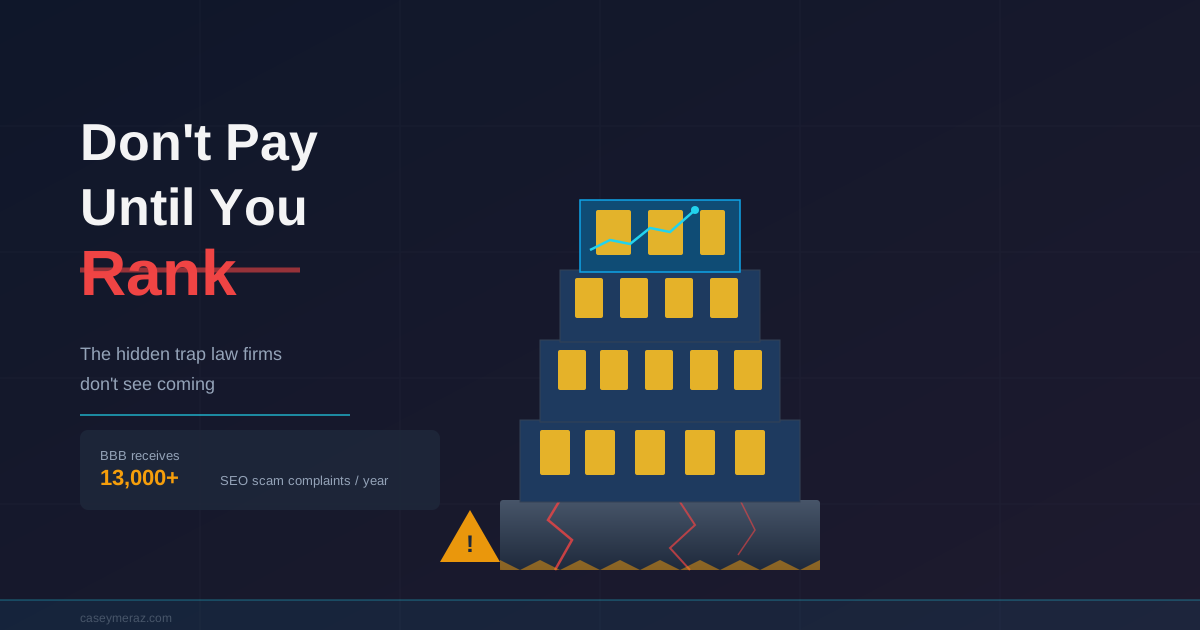
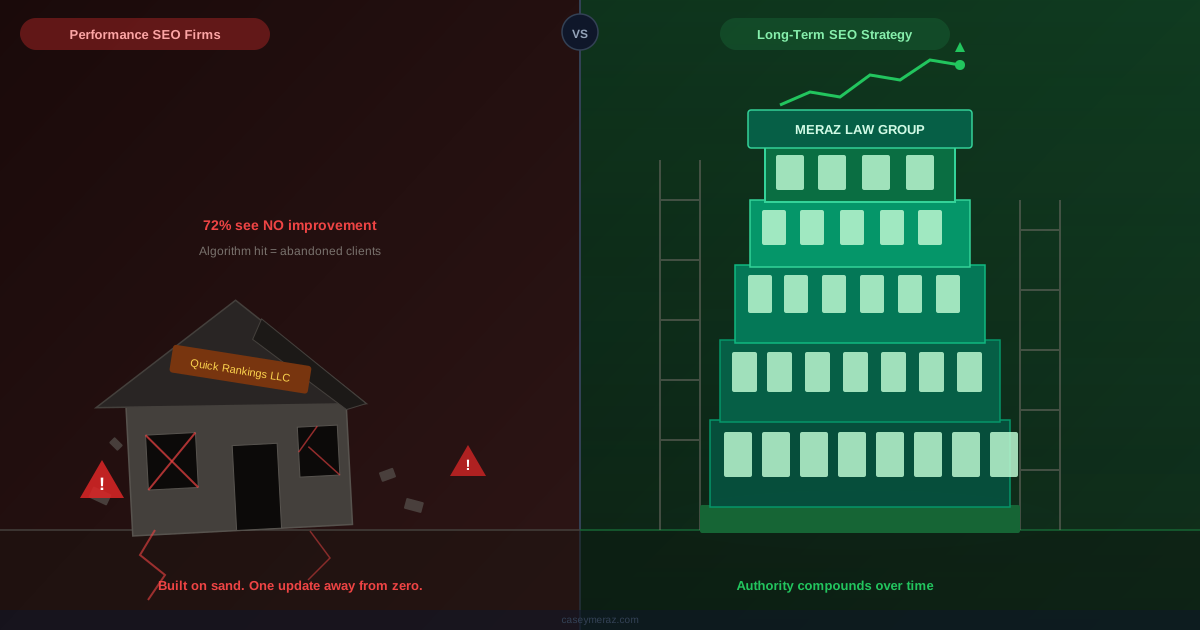
The Better Business Bureau receives more than 13,000 complaints annually about SEO and web design scams. A significant portion involve guaranteed ranking or performance-based promises. According to the same research, 72% of businesses that fell for SEO guarantee scams reported no significant improvement in rankings or traffic.
That’s not a fringe problem. That’s the industry norm for this model.
The Victorious SEO analysis of pay-for-performance firms put it clearly: “It promotes quick results without any thought to repercussions or sustainability.” One case study they documented showed a client whose rankings plummeted to two-year lows after their performance SEO agency used link manipulation tactics that got caught in a Google update.
Two years of work - and the investment in building those rankings - erased in days.
This is a Beginners’ Game
I want to be direct about something.
Small law firms sometimes have no choice. If you’re a solo practitioner in a competitive market and you have $500/month to spend, a performance model might be the only thing that gets you visible at all. I understand the constraint.
But if your firm is trying to build something - to dominate your market, to be the name in your city, to create something that has value beyond the next quarter - this model is incompatible with that goal.
The common SEO mistakes I see at established law firms almost always involve some version of this: chasing short-term rankings at the expense of long-term authority. It costs more to fix than it would have cost to build properly.
Real SEO is about building an asset. Your website should get more valuable over time, not more fragile. Strong E-E-A-T signals for law firm websites - Experience, Expertise, Authoritativeness, Trust - take time to build, but once established, they’re genuinely hard for competitors to displace. A site with years of authoritative content, quality backlinks from real legal publications, and a clean technical foundation doesn’t get wiped out by a Google update. It often benefits from those updates, because they’re designed to reward exactly what legitimate SEO builds.
The Ownership Trap Nobody Mentions
There’s another version of this problem that’s separate from the ranking tactics.
Stacey Burke’s breakdown of law firm SEO scams highlights something that trips up firms who switch away from performance agencies: website ownership. Some performance SEO companies build your site on their infrastructure. They own the domain. They own the content. When the relationship ends - either because Google tanked your rankings or you decided to move on - you walk away with nothing.
I’ve seen firms that built three years of “rankings” on a domain they didn’t own. When they left the agency, they had to start over completely. New domain, new content, new authority. That’s not a performance risk. That’s a trap.
Before signing anything with a performance SEO provider, get clear answers on:
- Who owns the domain?
- Who owns the website and its content?
- What happens to your rankings and your site if the contract ends?
If any of those answers involve the agency retaining ownership, walk away.
What Building a Real SEO Asset Looks Like
The alternative to performance SEO isn’t writing a big monthly check and hoping for the best. It’s investing in a law firm content strategy that builds topical authority over time, combined with technical foundations that hold up under algorithm scrutiny.
Specifically, firms that build durable SEO advantages do a few things differently:
They build real content depth. Practice area pages that actually answer client questions. Blog content that demonstrates expertise on specific case types. Resources that earn genuine links because they’re useful, not because they were placed on a network the agency controls.
They prioritize technical health. Fast load times. Clean site structure. Proper schema markup. Mobile optimization. These aren’t exciting, but they’re the difference between a site that recovers quickly from Google volatility and one that gets buried.
They earn citations from real sources. Legal directories, bar association profiles, news mentions, law school publications. These are the authority signals that Google and AI systems like ChatGPT increasingly rely on when evaluating whether to recommend or rank a firm. Our work in generative engine optimization for law firms is increasingly about these same foundations - they feed both traditional search and AI-driven recommendations.
They own everything. The domain. The content. The relationships. When you switch agencies or take SEO in-house, your asset goes with you.
The Business Case for Building It Right
Here’s what I’ve observed after 15 years of watching law firm marketing:
The firms that dominate their markets didn’t get there through tricks. They built authority systematically, year after year, until competing with them required an unreasonable amount of time and investment. Their organic rankings are essentially a moat.
Performance SEO firms can’t build that moat for you. By design, they’re optimizing for a specific set of keywords on a short timeline, using whatever tactics get there fastest. They’re not investing in your brand’s long-term authority because there’s no financial model that rewards that investment.
If you want to be the personal injury firm in Denver that everybody knows - the one that other attorneys refer cases to, that ChatGPT recommends, that appears at the top of every relevant search - that doesn’t come from a performance deal. It comes from years of consistent investment in content, authority, and technical quality.
That’s what I focus on with the firms I work with. Not gaming the next algorithm cycle. Building something that gets more valuable every year.
If you want to talk through where your firm actually stands - and what a real law firm SEO strategy looks like - let’s have a conversation.
Topics
Related Articles
Why Law Firms Need a Specialized SEO Expert in 2026
Discover why generic SEO agencies fail law firms and how a specialized law firm SEO expert can deliver significant results for your practice.
Read MoreGEO vs SEO: Preparing Your Law Firm for AI-Powered Search
As AI chatbots reshape how people find lawyers, Generative Engine Optimization (GEO) is becoming essential. Here's how law firms should adapt.
Read MoreLaw Firm Reputation Management: Protect Your Reviews and Win More Cases
A single 1-star review can cost your firm $30K+ in lost cases. Learn how to monitor, respond to, and build a review profile that converts searchers into clients.
Read MoreNeed Help With Your Law Firm's Marketing?
With 15+ years of experience helping law firms grow through SEO and digital marketing, I can help you develop a strategy that delivers results.
Let's Discuss Your Goals
Casey Meraz is the leading law firm SEO expert with 15+ years of experience helping attorneys dominate search results. As CEO of Juris Digital, he has helped hundreds of law firms grow through ethical, data-driven digital marketing strategies.